
 English
 Russian
 French
 Spanish
 Portuguese
 Italian
 Arabic
 German


Mifare 4K Stickers: Factory-Direct Custom RFID Stickers with Low MOQ & Free Samples
- Nov 25 , 2026
- By: Guangzhou Zhanfeng Smart Card Technology Co.,Ltd.
- Follow Us
A MIFARE 4K sticker is a thin RFID inlay with an adhesive backing, carrying a MIFARE Classic 4K die rather than the more common 1K chip. It sticks directly onto an asset, package, document, or device rather than inside a rigid card body, which makes it useful where a card would be too bulky to attach. The larger 4K memory gives each tag room for more data blocks and separate application areas, so one tag can carry identity, inventory, and access information. This guide explains what the chip offers, where the sticker form works, and what to check before ordering in volume.
The MIFARE Classic 4K die, often referenced as the S70, operates at 13.56 MHz under the ISO 14443A contactless standard, the same high-frequency family used by access control and membership systems. Its 4096 bits of memory are organised into 32 sectors, each with its own key A and key B and access conditions. The first sectors follow the familiar four-block layout of the Classic 1K, while later sectors use a larger block structure for the extra capacity. Readers that already handle MIFARE Classic can often support the 4K die once their firmware and configuration permit it.
The choice between 4K and 1K comes down to how much data each tag must carry. A 1K Classic card splits its 1024 bits into 16 sectors, enough for a single identity number, a few access groups, and small records. A 4K sticker adds sectors for multiple applications, longer inventory records, separate access zones, or data the system writes and updates over the tag's life. For a simple single-purpose tag, the 1K die usually covers the job at a lower cost.
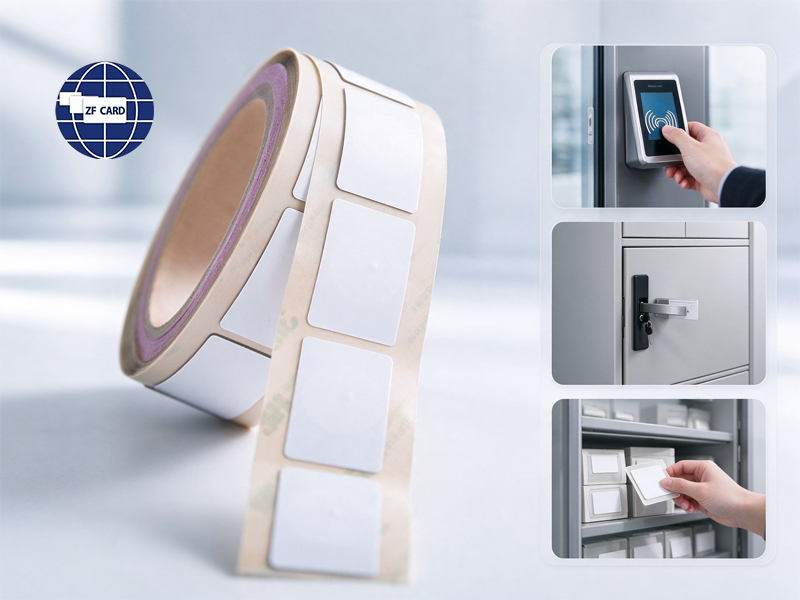
A MIFARE 4K sticker builds the antenna and die onto a flexible inlay sheet, then laminates a printable face material over it and an adhesive layer underneath. Stickers are cut to many sizes and shapes, from small square labels to round tags and narrow strips, and the face can be paper, synthetic plastic, or a matte or glossy film. With no rigid card body, the tag conforms to curved or uneven surfaces and sits flush against the item it labels. The antenna loop and face material both affect read performance, so size and backing should match the surface.
Common uses include asset tracking in offices and warehouses, labelling tools, laptops, and equipment; tagging books, files, and archives; marking packages, pallets, and stock in supply chains; and identifying props, exhibits, or containers. The format also suits temporary campaigns, where tags are applied to packaging or products and removed later. Any project that identifies many individual items quickly, without issuing a full card to each one, is a candidate for an adhesive RFID tag rather than a rigid credential.
The surface the sticker is attached to strongly affects whether it reads. High-frequency signals are disturbed by metal and damp or liquid-containing materials: a tag stuck onto a steel cabinet, metal enclosure, or liquid container can have a much shorter read distance or fail to respond. In those cases the factory may supply a ferrite-backed or spacer-based inlay that keeps the antenna away from the conductive surface. Paper, wood, plastic, and cardboard usually behave well, but the attachment material, thickness, and nearby metal should be described in the inquiry so the inlay matches the real surface.
Read distance on a sticker is generally shorter than on a standard card, because the antenna loop is smaller and there is no thick card body behind it. Distance depends on antenna size, reader output power, face material, and the surface behind the tag. A label for a small product may read only a few centimetres, while a larger tag on a flat non-metal surface reaches a more comfortable tap distance. Before bulk production, test the sticker on the actual item and reader, at the position staff will use, so the range is proven in the field rather than a desk demo.
Compatibility must be checked at the reader level. A MIFARE 4K sticker speaks the Classic protocol, but a reader configured or certified only for Classic 1K may not authenticate the S70 sectors, and some platforms restrict which chip size they accept. Confirm the reader model and firmware support 4K, and note whether the system verifies original NXP silicon or runs anti-cloning detection. Do not assume a reader that works with 1K tags will handle every 4K sector layout automatically; test the 4K tag on a representative terminal before changing the tag type across the fleet.
Appearance and printing are fully customisable. The face can carry a logo, brand colour, serial number, barcode, QR code, or member number, printed on one side with the antenna hidden behind the label. Synthetic face materials hold up better to handling and moisture than plain paper, while matte or gloss finishes match the brand look. Keep artwork clear of the antenna area and provide print-ready files so the design stays legible after cutting.
Personalisation follows the same encoding flow as other Classic tags. The factory can pre-write the UID rule if required, encode sector data from a provided CSV or database, apply sector keys, and lock blocks where write protection is needed. Each encoded tag should be read back after writing to confirm the data matches the source file. If your own bureau or reader station writes the data after delivery, stickers can be supplied blank, with die and antenna tested but no personalisation. State who encodes, the data format, and the key layout in the brief.
Low minimum order quantities make stickers practical for pilots, short runs, and campaigns that would not justify a full card production. A small first batch lets a buyer test the inlay on real surfaces, confirm read distance, and check print quality before committing to a repeat bulk order. Repeat orders then run on the same inlay, artwork, and coding setup recorded from the sample. The exact MOQ depends on chip availability, label size, and printing process, so it should be confirmed in the quote; standard stock dies and common sizes usually support smaller starts than custom tooling.
Two questions come up most often in selection. The first is whether 4K memory is really necessary: if each tag holds only one number and a small access record, a 1K die is usually enough and costs less, while 4K earns its place when multiple applications or larger records share the tag. The second is sticker versus card: a sticker attaches to an existing item and costs less to deploy, while a rigid card survives longer handling and a badge holder. Matching the form to what the tag attaches to prevents choosing a label that cannot survive its use.
Before accepting a bulk batch, verify a few acceptance points. Every tag should be recognised and authenticated by the reader, encoded data should read back correctly, and the adhesive should hold on the intended surface without lifting at the edges. Check print legibility on the variable numbers or codes, and spot-check read distance across several tags rather than one sample. Retain a few lot samples for traceability and note the inlay and face material, so repeat orders match the approved sample. These checks keep a low-MOQ sticker run consistent with the system that will read it.
This is the sticker-production profile ZF Card (Zhanfeng) has built over twenty years as a China-based original smart card and RFID manufacturer. We supply MIFARE 4K stickers, Classic 1K tags, NTAG and DESFire labels, cards, fobs, and inlays to buyers in more than a hundred countries, with die bonding, antenna attachment, lamination or label cutting, printing, encoding, and 100% read testing under one roof. For every 4K label order, our engineers confirm your reader model, firmware, sector layout, and attachment surface before quoting, and we name the exact die, antenna size, and face material in the offer.
We hold ISO 9001 and ISO 14001 certification and keep RoHS, REACH, and CE documentation ready for export projects. English-speaking account managers review the surface material and nearby metal in your installation, then arrange samples to test against your own reader before production. Each encoded sticker is checked after assembly, lot samples are retained for traceability, and defect and re-run terms are written into the order sheet. Common Classic and NFC dies are held in stock, and artwork, data files, and approved samples are kept on record for repeat orders, including low-MOQ first runs. We tune the antenna and label size to your reader and surface, and keep both stock and compatible dies on hand so a sample can be adjusted before the bulk run.
The safest way to approve a custom RFID sticker is to test it on your own reader and surface first. ZF Card ships free MIFARE 4K sticker samples to integrators, asset-tracking brands, and distributors worldwide — you cover the courier, and we send tags matched to your reader, artwork, and attachment material. Tell us your reader model and firmware, the surface the tag will stick to, the data or sectors you need, label size and finish, and projected annual volume, and we will reply within one business day with a compatibility note, a firm lead time, and a factory-direct quote.