
 English
 Russian
 French
 Spanish
 Portuguese
 Italian
 Arabic
 German


Polycarbonate ID Card Supply: Locking Lead Times to an Issuance Window
- Nov 23 , 2026
- By: Guangzhou Zhanfeng Smart Card Technology Co.,Ltd.
- Follow Us
A card program rarely has an open deadline. New hires, a population renewal, a facility go-live, or a member campaign sets a fixed issuance day, and every credential has to be on hand, encoded, and ready before that date. A supplier that quotes an agreeable price but slips the lead time leaves the issuer with a broken onboarding schedule, empty badge racks, and a last-minute rush. A reliable polycarbonate id cards supply arrangement is planned backward from that issuance window, not forward from a vague "when it's ready." This guide explains how lead time is built for PC ID cards, what can shift it, and how to lock the schedule before the order is placed.
Backward scheduling is the core method. Start from the date cards must be in hand, then walk the process in reverse: delivery and customs clearance, packing and final inspection, encoding and read testing, lamination and finishing, proof approval, artwork sign-off, and quotation. Each stage needs its own buffer, especially where a decision waits on the issuer — proof approval, key layout confirmation, and data delivery. A window that looks generous on the calendar collapses quickly if proof rounds or data handoff slip. Drawing the timeline backward shows which milestones must be met to keep the issuance date intact.
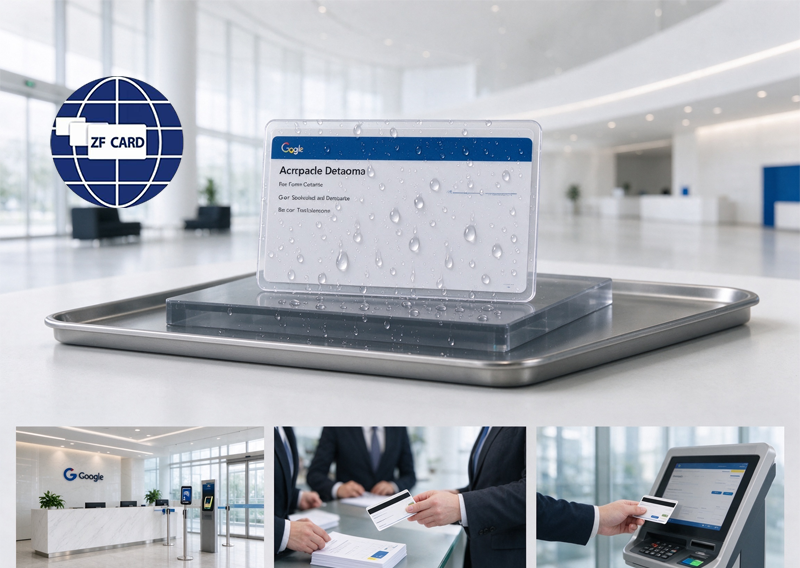
PC ID cards take longer to produce than PVC badges, and that difference should be reflected in the schedule. Polycarbonate needs a dedicated high-temperature, high-pressure lamination cycle, chip modules are milled and sealed into a cavity, and laser-personalisation layers are built into the stack rather than printed on the face. These steps cannot be skipped to save time the way a simple vinyl card can. A supplier running a converted PVC line may also struggle to hit a stable PC run on short notice. The PC lead time has to be planned for the material, not borrowed from a PVC estimate.
The production timeline breaks into clear stages after the order is confirmed. Artwork and layout are finalized, a physical proof is produced and approved, the inlays and modules are prepared, the cards are laminated and finished, the variable data is encoded and tested, and the batch is inspected, packed, and shipped. Each handoff between stages carries a small wait, and a delay in one stage moves the rest of the window. Asking the supplier to map these stages with working-day estimates gives you a schedule you can track, rather than a single date handed down without milestones.
Several variables move that schedule. Order quantity spreads across the press schedule; complex finishes such as foil, embossing, and UV add setup steps; chip modules and special substrates may need sourcing; personalisation data must arrive before encoding can start; and proof revision rounds add calendar time on the design side. Freight and customs clearance sit at the end of the chain and are often underestimated. A quote that bundles all of this into one lead-time number hides where the real schedule risk sits.
Chip and module stock is the most common source of a surprise delay in a polycarbonate id cards supply program. A common contactless or contact module held locally ships into the production schedule; a special chip or a restricted module may need to be allocated or air-freighted in, which stretches the window regardless of how fast the press runs. Confirm which chips and modules are in stock versus ordered in, and build that sourcing lead time into the backward schedule. A supplier who knows its own stock position can flag this before the PO rather than after the proof.
Variable data has its own rhythm. The encoded card cannot be produced until the issuer's serial list, key layout, or personalisation file is ready, and encoding cannot begin ahead of that data even if the blank cards are finished. Agree on the data format, delivery date, and check routine early: CSV or database mapping, duplicate-number check, and whether keys are written by the factory or supplied by the issuer. A late data file holds up encoding and packing, which usually cannot be recovered by speeding up the press.
Many programs issue in waves rather than one bulk batch. An initial rollout, a hire-on flow, and a later renewal each draw on the same design, plates, and encoded format. Keeping the artwork, data file, plates, and tooling on record for the supplier lets repeat orders skip the setup phase and meet shorter windows. A rolling issuance plan should agree up front on how replenishment batches are prioritized, what the repeat lead time is, and whether stock is held between waves, so later reorders do not restart the full production clock.
For a polycarbonate id cards supply program, supply stability matters as much as the first batch. Check the factory's capacity around your window, whether peak season or other orders could push your run back, and whether the line can scale if the program grows. Batch consistency across waves keeps cards interchangeable between readers. A supplier who can show its press schedule, its read-testing station, and retained lot samples offers more predictable supply than one who promises the shortest date without showing capacity.
The lead time should be written into the order terms, not left as a call promise. Record the working-day lead time measured from proof approval, the milestone dates for proof, production, encoding, and shipment, and a clear clause on late delivery and what triggers it. Include the defect acceptance threshold, retained lot samples, and the re-run responsibility so a defective batch does not consume the remaining window. Written milestones make schedule slippage visible early instead of discovered after the issuance date passes.
The issuer controls part of the schedule as well. Finalize artwork promptly after the proof, confirm the reader and personalisation equipment early, deliver the variable data by the agreed date, and keep the acceptance criteria clear so the sample does not cycle through endless revisions. A program that delays proof approval or data handoff cannot hold the supplier to a lead time that assumes those inputs arrive on schedule. Both sides' milestones should be listed together in the plan.
The recurring causes of slipped dates are predictable: repeated proof revisions, data arriving late, a chip or module out of stock, finishes added after the quote, and freight or customs delays at the end of the chain. When evaluating a supplier, ask for working-day estimates by stage, stock status on the required chip, past lead-time performance on comparable PC programs, and how an emergency batch is prioritized. A credible supplier answers these specifically; vague reassurance about being "flexible" is not a schedule commitment.
This is the supply and lead-time profile ZF Card (Zhanfeng) has built over twenty years as a China-based original card manufacturer. We handle polycarbonate id cards supply for government-oriented issuers, high-security badge deployments, and banking and industrial clients, alongside PVC cards for access, membership, and hospitality volumes, in more than a hundred countries. Our in-house line covers PC and PVC lamination, chip-module milling and sealing, hologram and UV layer insertion, offset and screen pre-printing, laser-ready layer structures, encoding, and 100% read and electrical testing under one roof, so production and encoding stay on a single tracked schedule.
We hold ISO 9001 and ISO 14001 certification and keep RoHS, REACH, and CE documentation ready for export buyers. English-speaking engineers map your issuance window backward, confirm your reader and personalisation equipment, and report chip and module stock status before the quote, then set milestone dates for proof, production, encoding, and shipment. Encoding runs in a badge-controlled room, every encoded unit is tested after assembly, lot samples are retained for traceability, and our defect commitment, re-run terms, and lead-time clause are written into the order sheet. Common chips and stock gauges are held in stock, with artwork, data file, plates, and tooling kept on record for repeat waves.
The fair way to judge a supply partner is to see the schedule and the sample before committing to a date. ZF Card ships free PC and PVC ID card sample packs to issuers, security integrators, and corporate security teams worldwide — you cover the courier, and we include a comparison card matched to your chip, laser, and artwork. Tell us your issuance date, project quantity, reader and personalisation equipment, and chip preference, and we will reply within one business day with a backward schedule, a firm lead time by milestone, and a factory-direct quote. Lock your polycarbonate id cards supply to a date you can plan around — request your free sample today.