
 English
 Russian
 French
 Spanish
 Portuguese
 Italian
 Arabic
 German

What Is a carte polycarbonate? Laser Engraving, Heat Resistance & Buyer Guide
- Nov 20 , 2026
- By: Guangzhou Zhanfeng Smart Card Technology Co.,Ltd.
- Follow Us
A carte polycarbonate is the French term for a polycarbonate card, the rigid engineering-plastic credential used wherever an ID has to last for years, resist tampering, and stay legible under real-world wear. If your search reaches this page from a French-speaking market or a bilingual procurement team, the product described here is the same high-security PC card supplied to national ID programs, police and military credentials, airport badges, and banking passes. This guide explains what the material is, how laser engraving and heat resistance set it apart, and what to check before ordering a PC card batch.
Polycarbonate is a rigid, optically clear engineering resin originally developed for glazing and impact-resistant panels, and those origins carry into card form. A carte polycarbonate is denser and stiffer than a vinyl card of the same CR80 size, resists bending and impact, and holds a flat shape across a decade of wallet or badge-reel use. It accepts fine textures, deep opaque colors, and clear or translucent finishes, and it bonds into a single monolithic sheet under lamination rather than a stack that can be peeled apart. That structural integrity is the base reason high-security programs choose it over PVC.
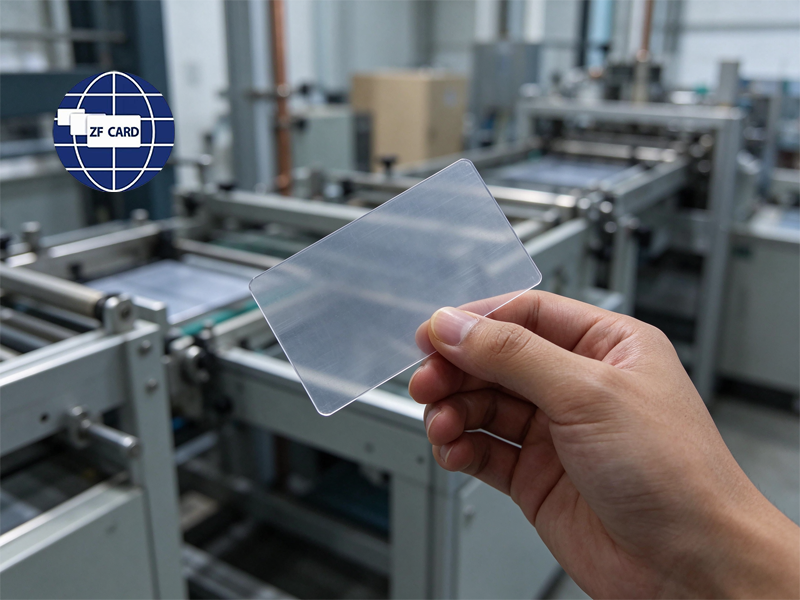
Heat resistance is one of the clearest practical differences. Polycarbonate stays dimensionally stable well past 120°C and tolerates the high-temperature, high-pressure cycle of a multi-layer card press, whereas PVC softens around 60–70°C and can warp on a summer dashboard. A carte polycarbonate therefore keeps its shape through a hot vehicle interior, a locked car in summer, and the warmth of an indoor access-control turnstile, without the curl or clouding that shows up on vinyl badges after months in the field. This thermal headroom is also what allows the card to carry buried laser-personalisation layers without the body distorting.
Laser engraving is the personalisation method that defines a modern PC card. A YAG or fibre laser ablates a colored layer buried inside the laminate, burning the holder's photo, name, ID number, and expiry date into the card body rather than printing them on the face. Once the laser fires, that image cannot be erased, overprinted, or transferred to another card. The engraved layer sits between the outer PC sheets, protected from abrasion and cleaning chemicals. The laser wavelength and power must match the specific layer structure the factory used, which is why a sample test burn matters before production.
Compared with surface printing, laser engraving lasts the life of the card. A thermal-printed or ink-printed face can be rubbed, wiped with disinfectant, or overprinted; an engraved image is inside the substrate and does not wear off with handling. Holograms, UV inks, guilloche backgrounds, and micro-text are likewise sealed between PC layers rather than applied on top, where they peel. For a credential that identifies an employee or a traveler at a checkpoint, this tamper-evidence is the feature the whole card rests on.
The card itself is built as a laminated sandwich. Outer printable face layers, middle security layers holding holograms and UV patterns, and a laser-personalisation layer near the centre are pressed together under heat and pressure. The chip module — contact, contactless, or dual-interface — is milled into a cavity and sealed flush before the final press. This architecture keeps every security feature inside the card, where lifting it off means destroying the card itself. A weak lamination bond is the failure most likely to appear after delivery, so press settings and layer symmetry are worth asking about.
PC cards earn their cost in specific roles. National IDs, driver licences, visas, and residence permits are obvious fits, along with military, police, and border-control credentials where a faked badge grants real physical access. Corporate programs for nuclear plants, data centres, airport restricted areas, and banking back-offices use PC badges because the credential is the first line of defence. By contrast, a regular office access card, a gym membership, or a temporary visitor pass usually does not justify the premium, and a PVC or composite card is the rational choice.
The material has limits buyers should plan around. Polycarbonate costs more per piece than PVC and needs a dedicated press reaching the temperature and pressure the material requires; a converted PVC line can produce bubbled or warped PC cards. It is moisture-resistant, not submersible, and it still has limits around prolonged water exposure. The personalisation printer or laser encoder must be tuned to the PC layer structure, and artwork laid out for a PVC thermal printer will not transfer cleanly. These are specification gaps, not material flaws, but they have to be closed before the order.
A practical buying guide starts with the equipment you already own. Confirm your laser personaliser's wavelength and power, your reader model and chip choice, and the security class the project requires. Ask the factory whether it owns a dedicated PC press and mills and seals chip modules in-house, because an outsourced milling step is where cracked modules and leaking sealant appear. Request a physical sample you can laser-burn and tap on your own reader before mass production, and check the certificate scope, lot retention, and a written defect and re-run clause. The sample run on your own equipment is the gate before tooling.
Common misconceptions are worth correcting. Polycarbonate is not automatically waterproof; it resists daily moisture and wiping, not immersion. A PC card does not replace a DESFire-level encrypted chip on its own — the substrate and the chip are separate decisions. Specifying PC but sending artwork sized for a PVC printer causes registration trouble, and skipping the personaliser-compatibility check usually surfaces after the cards arrive. Match the substrate, the chip, and the personalisation equipment as one system rather than choosing each in isolation.
The choice between PC and PVC follows the threat model. Choose polycarbonate for a decade-long, tamper-evident, high-security credential; stay with PVC for short-lived, low-risk, frequently replaced cards. When the project sits between the two, a physical comparison card of each substrate, bent, wiped, and laser-burned on your own equipment, resolves the question faster than any datasheet.
This is the PC card production profile ZF Card (Zhanfeng) has built over twenty years as a China-based original card manufacturer. We produce carte polycarbonate cards for government-oriented programs, high-security badge deployments, and banking and industrial clients, alongside PVC cards for access, membership, and hospitality volumes, in more than a hundred countries. Our in-house line covers PC lamination, chip-module milling and sealing, hologram and UV layer insertion, offset and screen pre-printing, laser-ready layer structures, encoding, and 100% read and electrical testing under one roof.
We hold ISO 9001 and ISO 14001 certification and keep RoHS, REACH, and CE documentation ready for export buyers. English-speaking engineers review your personalisation equipment, reader model, and security class before quoting, then send a physical sample for a test burn on your own laser and reader before the press run. Encoding runs in a badge-controlled room, lot samples are retained for traceability, and our defect commitment and re-run terms are written into the order sheet; artwork, data file, and tooling stay on record for repeat orders. We tune each card to your personaliser wavelength and reader before the production run, and every encoded unit is read-tested after assembly.
The fair way to judge a PC card is to burn your own data onto it and run it through your own reader. ZF Card ships free polycarbonate card sample packs to government-adjacent issuers, security integrators, and corporate security teams worldwide — you cover the courier, and we send blank and partially pre-laminated cards matched to your chip, laser, and artwork.
Tell us your personalisation equipment model, chip choice, and project security class, and we will reply within one business day with a compatibility note, a firm lead time, and a factory-direct quote. Request your free carte polycarbonate sample today and inspect the lamination, the seal, and the laser burn yourself.