
 English
 Russian
 French
 Spanish
 Portuguese
 Italian
 Arabic
 German


China Warranty Card Suppliers: Factory-Direct vs Trading Company, 5 Red Flags
- Nov 20 , 2026
- By: Guangzhou Zhanfeng Smart Card Technology Co.,Ltd.
- Follow Us
When you search China warranty card suppliers for a bulk guarantee-card order, two kinds of reply land in your inbox. One runs the printing, finishing, and encoding on its own line; the other collects your order, places it with a factory somewhere, and adds a layer in between. On paper both look like a supplier, and the price difference can be small. The separation shows up when a batch arrives misprinted, when a code will not scan, or when a delay needs a decision fast. This guide explains what factory-direct and trading company actually mean, and the five red flags that identify a supplier you should move down the list.
A factory-direct producer owns the machines and the people: inlay or card cutting, lamination, offset or screen printing, foil and embossing, variable encoding, and packing under one roof. It can answer a question about a defect by walking to the station that made it. A trading company does not run production; it brokers the order to one or more factories, marks up the cost, and coordinates the handoff. Traders can be useful for small mixed orders and multi-category sourcing, but they add a communication layer, a markup, and a responsibility gap, because they cannot change a press setting themselves.
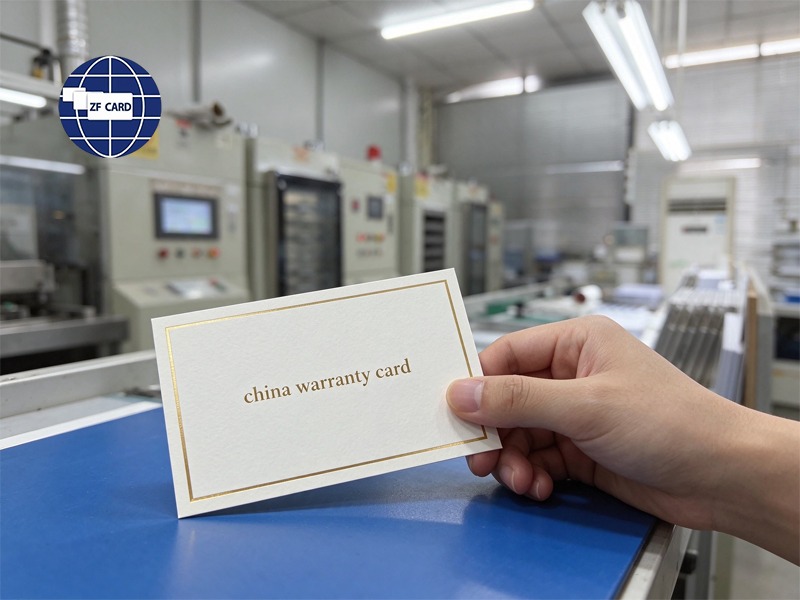
Red flag one is a refusal to show the production floor. Ask for a live video call of the printing or encoding line while it is running, not a showroom tour and not a folder of stock photos. A real factory can point to the press, the encoder, the QC station, and the finished-card cartons. A trader usually cannot produce that footage, because the work happens at a plant it does not control. If the supplier deflects the request with a promise to send photos later, that avoidance is itself the signal.
Red flag two is a vague or suspiciously low quote. A reliable quotation names the material and thickness, the print colors, the finishes, whether encoding is included, the MOQ, and the packaging. A reply that returns one flat number without these details, or sits well below every other bid, has usually priced the cheapest possible version and will add missing items later. Watch for a supplier who cannot name the chip or code type, the ink standard, or the card gauge, because those are the facts a factory knows from the first message.
Red flag three is a sample that does not match the bulk order. Some brokers send a polished sample made by one factory, then place the bulk run with a cheaper plant that cannot reproduce the finish or the code read. Ask whether the sample is produced on the same line as the production batch, and whether every encoded card is read-tested after assembly. A supplier who has no encoding room of its own, and cannot describe how codes are checked, is outsourcing the step where most warranty-card defects appear.
Red flag four is a contract with no written responsibility. Ask who absorbs cost when a batch arrives misprinted, scratched, or with dead codes, and whether a replacement run and expedited freight are covered. Ask for an NDA before artwork and serial ranges are exchanged, and a written defect commitment and re-run clause. A trader who forwards the complaint to the factory has little leverage over the re-run; a factory-direct producer owns the defect and the remedy. Verbal promises on a call do not survive a dispute.
Red flag five is paperwork that does not match the product. Check that ISO 9001 and any environmental certification list card manufacturing in their scope, not a generic trading registration, and that RoHS and REACH declarations match the material and ink you will receive. Ask whether a retained sample from each lot is kept for traceability. A supplier who cannot produce a verifiable certificate number, or who supplies generic declarations after the order, has no quality system behind the cards.
You can sort this out in the first RFQ round. Send the same four questions to every candidate: material and gauge, finishes and encoding, monthly capacity and working-day lead time, and a video of the production line. Replies that arrive complete and specific within a day point to factories; late, vague answers that request a call before any detail point to brokers. Compare the physical samples side by side for thickness, foil edge, print registration, and code scan, because the sample is the closest preview of the bulk batch.
Warranty cards carry category-specific risks worth checking. A QR code printed too small or over a dark background will not scan to the verification page. Colors shift when artwork arrives in RGB instead of CMYK. Serial numbers repeat when the data file is not checked against the encoder list. Cheap ink fades against sweat or hand cream, and a thin card warps in a pocket. A factory that controls its own printing and encoding can catch these at proof stage; a broker has to relay the problem through two or three hands before it reaches the machine.
Trading companies are not always the wrong choice. For a tiny first order, a mixed carton of different products, or a buyer who wants one contact across several suppliers, a trader can simplify sourcing. The condition is that the responsibility chain stays clear: who holds the NDA, who owns the defect, who keeps the data file, and who re-runs a bad batch. If those answers point back to an unnamed third party, the convenience of one contact becomes a risk at the first problem.
For buyers sorting through china warranty card suppliers, factory-direct sourcing pays off most on repeat and branded programs. Communication reaches the engineer who can adjust the layout or the encoding, problems are diagnosed on the spot, and the artwork, data file, plates, and print film stay on record so a reorder does not repeat setup work. For a warranty card that carries the brand's name into every customer's wallet, that direct line between design and production is what keeps the batch consistent across the first order and the tenth.
This is the supplier profile ZF Card (Zhanfeng) has built over twenty years as a China-based original card manufacturer. We produce custom guarantee and warranty cards for watch, jewelry, electronics, leather, eyewear, and cosmetics brands, alongside member and access cards, in more than a hundred countries. Our in-house line covers PVC and PETG cutting, offset and screen printing, foil stamping, embossing, spot UV, doming, variable serial and QR encoding, and packing, so a card moves from artwork to finished unit without a middle handoff. As one of the established china warranty card suppliers buyers can video-call on the production floor, we name the material, finish, and code on every quote.
We hold ISO 9001 and ISO 14001 certification with a manufacturing scope and keep RoHS, REACH, and CE documentation ready for export buyers. English-speaking account engineers review your artwork for CMYK conversion, code size, bleed, and finish placement before quoting, then send a physical proof matched to your design before the press run. Encoding runs in a badge-controlled room, every encoded card is read-tested after assembly, lots are retained for traceability, and our defect commitment and re-run terms are written into the order sheet. Artwork, data file, plates, and print film stay on record for repeat orders.
The fair way to judge a warranty card supplier is to see the line and hold the finished card yourself. ZF Card ships free sample packs to brand owners, distributors, and packaging converters worldwide — you cover the courier, and we send printed PVC cards matched to your artwork, finish, and code requirement.
Send your product category, preferred material and finishes, artwork or template idea, code type if any, and projected annual quantity, and we will reply within one business day with a factory-direct quote, a firm lead time, and a low-MOQ option. Run these five red-flag checks on any shortlist of china warranty card suppliers, then request your free sample and compare the print, the foil, and the code read on a real card before you commit to bulk production.