
 English
 Russian
 French
 Spanish
 Portuguese
 Italian
 Arabic
 German


How to Choose the Right TK4100 RFID Inlay for Smart Card Production
- Nov 25 , 2026
- By: Guangzhou Zhanfeng Smart Card Technology Co.,Ltd.
- Follow Us
Understanding TK4100 RFID Inlays
For smart card manufacturers, selecting the right RFID inlay is an important step in ensuring consistent card performance and efficient production. Among low-frequency RFID solutions, the TK4100 inlay remains a practical choice for applications such as access control, employee identification and attendance management.
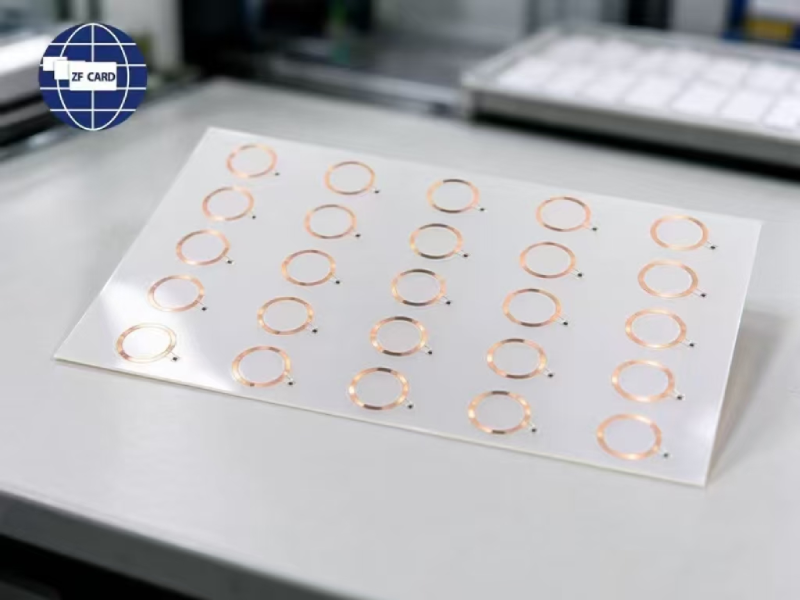
A TK4100 RFID inlay is a semi-finished component consisting of a TK4100 chip and an antenna coil embedded in a substrate material. It is designed to be laminated between PVC or other suitable materials during smart card manufacturing.
Operating at 125kHz, the TK4100 chip uses a read-only identification system. It contains 64 bits of data, including a 40-bit unique identification number (UID). Each chip carries a factory-programmed identification code, allowing compatible readers to recognize individual cards without requiring batteries.
For manufacturers producing large quantities of identification and access cards, TK4100 inlays offer a straightforward and cost-effective solution.
Key Factors to Consider When Choosing a TK4100 Inlay
Not all TK4100 inlays are identical. Before placing a bulk order, manufacturers should evaluate several technical and production-related factors.
Chip Compatibility and Reader Requirements
The first consideration is whether the TK4100 chip is compatible with the customer's existing access control system. TK4100 is commonly associated with the EM4100 communication format and operates at 125kHz.
However, frequency compatibility alone does not guarantee that every card will work with every reader. Buyers should confirm the required communication format, identification code structure and reader specifications before production.
This is particularly important for projects involving existing access control equipment, where replacing the entire reader system may be costly.
Antenna Design and Reading Performance
The antenna coil is another important component of an RFID inlay. Its geometry, number of turns and electrical characteristics influence the inlay's resonant performance and communication with the reader.
A poorly matched antenna may result in unstable reading performance or reduced reading distance. Therefore, manufacturers should consider antenna dimensions and chip characteristics together rather than evaluating the chip alone.
For large-volume production, testing sample inlays with the intended readers before mass production is a practical way to identify compatibility issues early.
Material, Thickness and Sheet Layout
The substrate material and physical dimensions directly affect the subsequent lamination process.
Common considerations include:
Material: PVC is widely used in conventional smart card production. Other materials may be considered depending on the manufacturing process.
Thickness: Different thickness options should be selected according to the required final card thickness and lamination structure.
Sheet size: A4 and larger industrial sheet formats may be suitable for different production equipment.
Layout: Arrangements such as 3×8, 4×8 or 5×5 can help manufacturers match their cutting and production requirements.
Choosing the correct layout can improve material utilization, reduce unnecessary waste and make downstream processing more efficient.
Common Applications of TK4100 RFID Inlays
TK4100 inlays are mainly used in identification systems where a fixed identification number is sufficient.
Typical applications include:
Access Control Cards: Used in offices, residential buildings, factories and other controlled-access environments.
Employee ID Cards: Help identify employees and connect card numbers with personnel management systems.
Attendance Cards: Support employee check-in and check-out through compatible 125kHz readers.
Membership Cards: Provide a simple identification method for gyms, clubs and other membership-based organizations.
Industrial Identification: Used for equipment identification and other applications requiring a unique electronic ID.
One important point for buyers is that TK4100 is a read-only chip. It is not suitable for applications that require users to rewrite card data or store changing information directly on the chip. In these situations, a rewritable alternative may be more appropriate.
How to Ensure Consistent Quality Before Mass Production
For smart card manufacturers, the quality of the inlay directly influences the reliability of the finished card. A small defect in the chip or antenna may cause reading failures after lamination.
Before confirming a bulk order, buyers should pay attention to several quality control points.
First, check the chip type and verify that the inlays meet the required technical specifications. Second, inspect antenna alignment, sheet dimensions and overall material consistency. Third, conduct reading tests using compatible 125kHz readers.
It is also advisable to test the inlays after lamination. Heat and pressure during the lamination process may affect the finished product if the materials and processing parameters are not properly matched.
Working with a manufacturer that understands both inlay production and smart card manufacturing can help reduce these risks.
Why Choose ZF Card for TK4100 Inlay Supply
As a direct smart card manufacturer in China, ZF Card (Guangzhou Zhanfeng Intelligent Technology Co., Ltd.) has more than 20 years of experience in the smart card industry.
We understand that different card manufacturers have different requirements for chip models, sheet dimensions, material thicknesses and production layouts. Therefore, we focus on providing practical solutions that match customers' manufacturing needs.
Our advantages include:
Direct Factory Supply: Manufacturing experience and production support for domestic and international customers.
Customization Options: Support for discussing suitable sheet sizes, thicknesses and inlay layouts according to project requirements.
Technical Assistance: Help customers confirm chip specifications and production compatibility before ordering.
Free Samples: Sample support is available for customers who want to evaluate product quality and test compatibility before bulk purchasing.
Whether you are producing access control cards, employee ID cards or other 125kHz identification products, selecting a suitable TK4100 inlay is an important step toward stable and efficient manufacturing.
Request a TK4100 Inlay Sample or Quotation
Looking for a reliable TK4100 inlay manufacturer for your smart card production?
Contact ZF Card and share your required chip type, sheet dimensions, thickness, layout and estimated order quantity. Our team can help evaluate your requirements and recommend a suitable solution.
We welcome inquiries from smart card manufacturers, distributors and wholesale buyers worldwide. Contact us today to request free samples and discuss your next production project.