
 English
 Russian
 French
 Spanish
 Portuguese
 Italian
 Arabic
 German


What Criteria Should You Check When Choosing Plastic Card Producers?
- Nov 03 , 2026
- By: Guangzhou Zhanfeng Smart Card Technology Co.,Ltd.
- Follow Us
"Plastic card producer" sounds like a simple search term, but the suppliers behind it range from one-room trading shops to fully integrated factories that print, encode, and pack tens of millions of cards a month. Choosing between them decides whether your membership program, gift card launch, employee badge rollout, or retail loyalty campaign ships on time, reads correctly, and looks like your brand. The criteria below are the ones procurement teams actually use to separate a real factory from a reseller before a deposit changes hands.
Start with the product itself. A plastic card is usually a 0.76 mm CR80 rectangle (85.6 × 54 mm) laminated from PVC, PETG, or ABS sheets, sometimes with a chip, magnetic stripe, signature panel, or scratch-off panel pressed into it. PVC is the everyday choice, PETG is the more durable and eco-friendly upgrade, and ABS is the rigid option for thick or shaped cards. A producer that cannot tell you which substrate your artwork requires — and why — has not run a real press.
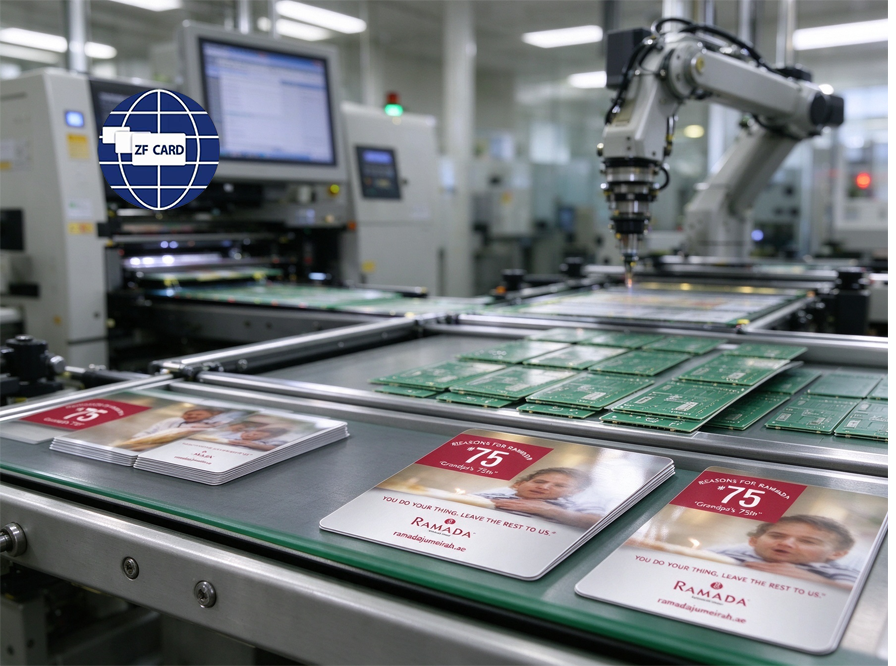
The first criterion is vertical integration. Ask which production stages the factory owns on site: inlay bonding for chip cards, lamination presses, offset or screen printing equipment, encoding stations, die-cutting, and packing. A factory that owns all six controls its own quality and lead time. A reseller that outsources printing to a neighbor and lamination to another shop can quote the same price, but every outsourcing handoff is a place where your delivery date slips. A video walkthrough of the floor is worth ten glossy brochures.
The second criterion is certification. At minimum, look for a current ISO 9001 quality certificate issued by an accredited body, with a scope that actually covers card manufacturing. For export buyers, ISO 14001 environmental certification, RoHS and REACH declarations on PVC and ink, and FSC or recycled-plastic documentation support your own sustainability claims. Ask for the certificate number and expiry date; real factories let you verify online, while traders often email a scanned image that falls apart under inspection.
The third criterion is print and customization depth. A basic producer runs four-color offset and ships blank cards. A strong producer adds screen printing for solid brand Pantones, hot foil stamping in gold or silver, embossing and debossing, spot UV, magnetic stripe encoding, signature panels, scratch-off panels, barcode and QR variable data, and serial number laser etching. The wider the capability, the more future card designs you can build around the same supplier rather than re-tendering every product launch.
The fourth criterion is quality control. Ask for incoming-material inspection on card stock and chip reels, in-process sampling on the press, and outgoing inspection — 100% read-and-encode testing for encoded cards, AQL 2.5 sampling for printed blanks. Ask what defect rate they commit to in writing; a mature line should sit below 0.3%. Ask whether they retain a sample from each production lot for traceability. A factory that cannot answer these questions on the first RFQ round is a factory that will not accept a defect claim later.
The fifth criterion is capacity and lead time. Ask for monthly output in pieces for blank cards, printed cards, and encoded cards separately, and ask for current backlog. A standard printed-and-encoded CR80 card should leave the door in 10–15 working days after proof approval. Ask what happens if you need 30% more cards at peak season, and whether that surge is absorbed on the same press or subcontracted. Tie the delivery date and a late-delivery penalty into the pro forma invoice rather than trusting a verbal promise.
The sixth criterion is data security. If your cards carry member names, membership numbers, encrypted sector keys, or gift-card PINs, ask how the encoding room is secured. Real factories run badge-access encoding stations with no removable media, logged operator use, and a written key-handling procedure. They sign an NDA before artwork and keys are exchanged, and they destroy unused pre-production samples after approval. A reseller that has never thought about these questions will not be able to answer them, which is itself the answer.
The seventh criterion is commercial transparency. Ask whether the quote separates sampling cost, plate cost, print cost, encoding cost, packaging, and freight. Ask whether they ship DDP door delivery for small air shipments or FOB Shenzhen for sea freight. Ask for payment terms (T/T 30/70 is standard) and for a re-run clause if a batch arrives out of spec. The goal is no surprise invoices after the PO — plate charges, artwork revision fees, and inspection fees should be on the table on day one.
The eighth criterion is proof and sampling discipline. A real producer sends a digital proof, then a physical color proof matched to your Pantones, then a pre-production sample you can test on your own reader or POS terminal, before mass production. They do not start printing the moment you email "approved." Skipping that physical proof step is how brands discover the blue on the card is three shades off the blue on the box — after ten thousand units are on a ship.
The ninth criterion is reference customers. Ask for two buyers in your industry segment and a short project history — product type, batch size, delivery window, and what went wrong once. A factory that has shipped to hotels, retailers, banks, or loyalty programs before you has already solved the problems you are about to have. A factory that only offers testimonials on a landing page has not actually delivered at your scale.
This is the producer profile ZF Card (Zhanfeng) has built over twenty years as a China-based original plastic card manufacturer. We print, laminate, encode, and pack PVC, PETG, and ABS cards — gift cards, membership cards, hotel key cards, employee badges, RFID stickers, wristbands, and key fobs — out of one integrated facility, and we supply buyers, distributors, and brand owners in more than a hundred countries. We hold ISO 9001 and ISO 14001 certification, keep RoHS, REACH, and FSC documentation ready, and run a badge-access encoding room for serialized and encrypted projects. Our line runs offset, screen, hot foil, emboss, magnetic stripe, and variable-data printing in-house, and we deliver a serial CSV with every personalized run.
Because we own every production stage, we quote sampling, lead time, and defect rate in writing on the pro forma invoice, and we send a physical color proof and an encoded test card before mass production. English-speaking account engineers own each order from artwork approval through reorder, so your questions never pass through a third party. We also match each card to your reader, POS, or lock system on a test bench before pressing the production run.
The fastest way to judge a plastic card producer is to hold their cards next to your own packaging. ZF Card ships free plastic card sample packs to brand owners, distributors, and system integrators worldwide — you cover the courier, and we send blank and printed cards in PVC and PETG, with samples of hot foil, spot UV, magnetic stripe, and variable data applied to your artwork.
Tell us your card type, your print finish, your reader or POS model, and your projected annual volume, and we will reply within one business day with a recommendation, a firm lead time, and a factory-direct quote. Stop choosing card producers on unit price alone — request your free plastic card sample pack today and feel the lamination, the print registration, and the read that twenty years of specialized card manufacturing actually delivers.