
 English
 Russian
 French
 Spanish
 Portuguese
 Italian
 Arabic
 German


How to Select Polycarbonate ID Cards for High-Security Identification Projects
- Oct 30 , 2026
- By: Guangzhou Zhanfeng Smart Card Technology Co.,Ltd.
- Follow Us
When an ID card has to survive a decade of daily use, resist tampering, and be trusted at an airport checkpoint or a nuclear-plant gate, polycarbonate is the material the world's national ID programs, driver-licence agencies, and high-security corporate deployments reach for. PVC is cheap and flexible, but it can be reprinted, peeled, and altered. Polycarbonate (PC) cards cannot. They are the de facto substrate for e-passport booklets, national ID cards, military credentials, and the most demanding employee badges. Here is what procurement teams should know before selecting a PC card supplier.
The difference starts with the material. Polycarbonate is a rigid, optically clear engineering polymer originally used for aircraft canopies and bullet-resistant glazing. As a card substrate it is scratch-resistant, temperature-stable across -40 to 120°C, immune to most solvents, and nearly impossible to peel apart without destroying the card. Where a PVC card delaminates in a wallet after three years, a PC card stays flat and legible for ten or more. That longevity is why government programs amortise the higher unit cost across a full card lifecycle.
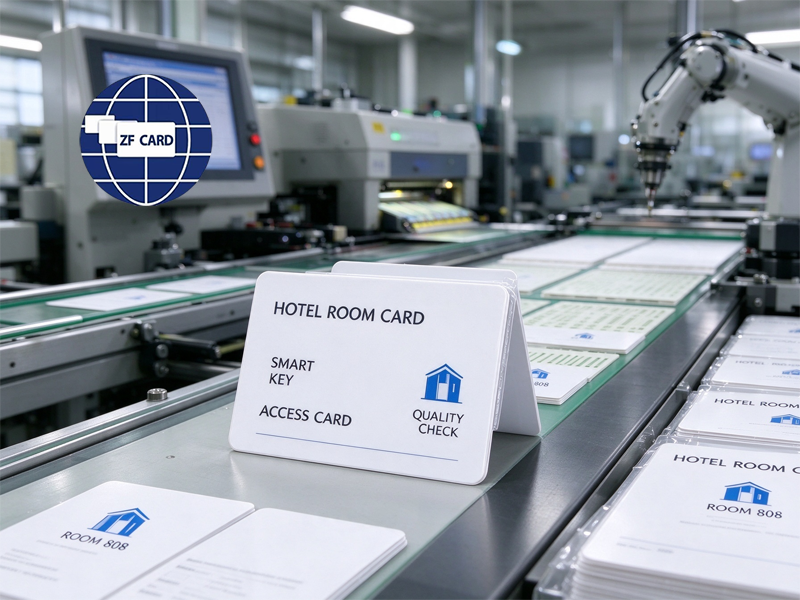
PC cards are built as a laminated sandwich, not a single printed sheet. A typical structure stacks four to seven layers: printable core layers on the outside, security layers in the middle holding holograms, UV-visible patterns, guilloche backgrounds, and laser-personalization layers near the centre. The chip module — contact, contactless, or dual-interface — is milled into a cavity and sealed before the final press. This architecture means the security features sit inside the card rather than on top of it, which is exactly what makes them hard to lift off and transfer.
Personalisation is the step that separates PC cards from PVC. A thermal-printer PVC badge can be reprinted or overprinted. A PC card is normally personalised by laser: a YAG or fibre laser ablates a coloured layer buried inside the sandwich, burning the holder's photo, name, ID number, and expiry date into the card body. Once the laser has fired, the image cannot be erased, altered, or transferred to another card. For border-control and law-enforcement projects this tamper-evidence is non-negotiable, and it is why every serious PC card order specifies a laser-personalization layer rather than an ink-printed surface.
The security feature set should be specified project by project. Baseline features include a holographic overlay or a diffraction structure inside the laminate, ultraviolet-fluorescent inks invisible under normal light, micro-text lines that need a magnifier, and a guilloche background that cannot be scanned and reprinted. Higher grades add an optically variable image (OVI), a tactile relief, a serial number laser-etched into the edge, and a digital watermark that survives photocopying. For government-issued cards, ICAO 9303 and ISO/IEC 7810 form factors must be respected; for corporate high-security badges, the local standard usually tracks those same dimensions.
Chip selection follows the use case. Contact chips in ID-1 form factor, such as the common SD-card-sized modules used in national ID and driver-licence cards, suit government and ePassport-adjacent programs. Contactless DESFire EV3 or similar CPU chips suit corporate access, since the card never leaves the holder's pocket. Dual-interface cards combine both on one substrate and are the standard for eMRTD and multi-application national programs. Ask the supplier which chip modules they can mill and seal in-house, because an out-sourced milling step is where many defects — cracked chips, leaking sealant, and weak bond — show up.
Polycarbonate ID cards earn their cost in specific roles. National ID, driver licences, visas, and residence permits are obvious fits. Military, police, and border-control credentials, where a faked badge can grant real physical access, are another. Corporate programs for nuclear plants, data centres, airport restricted areas, and banking back-offices use PC badges because the badge is the first line of defence. By contrast, a regular office access card, a gym membership, or a temporary conference pass does not justify PC's unit cost, and a PVC or composite card is the rational choice. Match the substrate to the threat model, not to the budget line.
On the procurement side, pin down five things before quoting. First, confirm the supplier's lamination press can reach the temperature and pressure profile PC requires — roughly 120–140°C and several tons of platen pressure, well above PVC settings. A PVC converter running a converted press will produce bubbled or delaminated PC cards. Second, confirm they supply either blank pre-laminated PC cards or fully inlay-embedded cards matched to your personalisation equipment's laser wavelength. Third, ask for a sample card you can run on your own laser personaliser before approving mass production, because layer sensitivity varies by supplier. Fourth, insist on an NDA and a secure-production room, since you will be sharing artwork, hologram designs, and serial-number ranges. Fifth, write a below-0.3% defect acceptance and a re-run clause into the PO.
Buying from China for a PC ID program also carries specific checks. Ask whether the converter has experience shipping to government or defence buyers, and whether they can support restricted-material classification and end-use documentation. Ask for their in-house lamination and milling photos, not just their showroom shots. Ask whether they stock the chip modules you need or air-freight them in, because lead-time risk is the single most common project delay. A credible supplier will answer all of this on the first RFQ round.
This is the production profile ZF Card (Zhanfeng) has built over twenty years as a China-based original card manufacturer. We produce blank and personalised polycarbonate ID cards for government-oriented projects, corporate high-security badge programs, and banking and industrial clients in more than a hundred countries. Our in-house line runs PC lamination, chip-module milling and sealing, hologram and UV layer insertion, offset and screen pre-printing, and 100% read and electrical testing under one roof. We hold ISO 9001 and ISO 14001 certification, support contact, contactless, and dual-interface modules, and tune each card to the buyer's laser personaliser wavelength before mass production.
Because PC cards are unforgiving of a mismatched lamination curve, we send physical sample cards first and have your personalisation partner run a test burn before we press the production run. English-speaking account engineers own each order from artwork approval through serial-number CSV delivery, with a written lead time and a defect-rate commitment in the contract. We also sign mutual NDAs and support restricted end-use documentation for projects that require it.
The only fair way to judge a polycarbonate ID card is to laser-burn your own data onto it and run it through your reader. ZF Card ships free PC ID card sample packs to government-adjacent issuers, high-security badge integrators, and corporate security teams worldwide — you cover the courier, and we send blank and partially pre-laminated cards matched to your chip and laser spec. Tell us your personalisation equipment model, your chip choice, and your project's security class, and we will reply within one business day with a compatibility note, a firm lead time, and a factory-direct quote. Stop treating high-security ID like a commodity card order — request your free polycarbonate ID sample today and see the lamination, the seal, and the laser burn that twenty years of specialised card manufacturing actually delivers.