
 English
 Russian
 French
 Spanish
 Portuguese
 Italian
 Arabic
 German


How to Select Mifare Classic 1K Sticker for Access Control & Asset Tracking Projects
- Oct 22 , 2026
- By: Guangzhou Zhanfeng Smart Card Technology Co.,Ltd.
- Follow Us
When an IT department wants to tag a laptop, a facilities team needs to label a rolling tool case, a library wants to inventory every hardcover, or a conference organizer issues temporary visitor badges, the answer is often a MIFARE Classic 1K sticker: a thin, self-adhesive RFID label built around an NXP MIFARE Classic 1K chip and antenna loop, designed to stick onto surfaces where a card will not fit. Unlike the plastic card everyone keeps in a wallet, the sticker format exists to be applied at volume, on irregular shapes, and in places that never had an RFID port before. But sticker selection in a tender document reads simple on the surface — chip, size, adhesive — and hides a set of decisions that decide whether the project works after deployment. This guide walks through what a MIFARE Classic 1K sticker actually is, how to match it to your surface, and the checks to run before you order ten thousand labels for an access-control or asset-tracking rollout.
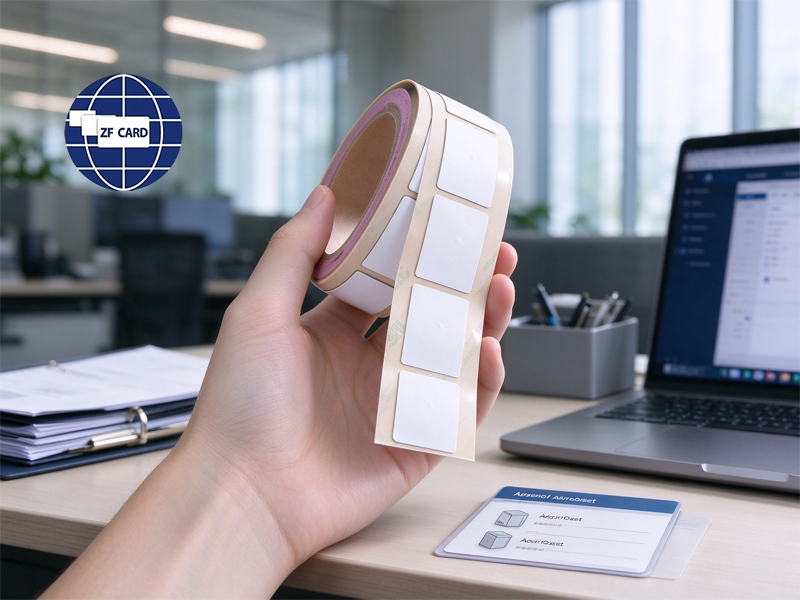
First, the silicon. A genuine MIFARE Classic 1K sticker contains an NXP Semiconductors MF1S50 (or equivalent documented Classic 1K) die, running at 13.56 MHz under ISO/IEC 14443 Type A, with 1 KB of EEPROM split into 16 sectors and 64 blocks — the exact memory map readers already know from standard cards. The chip holds a 4-byte or 7-byte unique identifier, supports sector-key authentication with two independent 48-bit keys per sector, and reads and writes in well under a quarter second. Because the protocol is identical to a standard MIFARE Classic 1K card, most access-control panels, NFC phones, library systems, and fixed RFID readers accept the sticker blank without a firmware change; the reader simply sees another Classic 1K device on the same RF channel. This protocol continuity is the reason sticker-format Classic 1K labels sit inside the same procurement universe as the cards, even though their physical form is different.
The body of the sticker determines where it can live. Standard labels are paper or synthetic-paper (Tyvek-like) tags printed on a matte surface, 0.3–0.5 mm thick, usually round (25 mm, 30 mm, or 35 mm diameter) or square (30 × 30 mm, 40 × 40 mm). PET or vinyl labels add scratch resistance and cleaning tolerance, which matters on tools, vehicles, or equipment that gets wiped down. Heavy-duty asset tags move to thicker polycarbonate or brushed-metal-look stock, die-cut into shields, flags, or wrap-around shapes for cylinders and hand tools. Every sticker still contains the same antenna loop under the print, and that loop defines the read range: typical non-metal labels read 2–5 cm from a handheld NFC phone or short-range fixed reader, while well-tuned 35 mm round labels can reach 6–8 cm on a good fixed reader. Size and antenna shape are a coupled choice, not two independent line items on a spec sheet.
The single most common project failure mode is attaching a standard sticker to metal. The metal surface absorbs and shorts the 13.56 MHz field, so a regular label pasted directly onto a steel tool chest, a server chassis, a machine frame, or a metal briefcase reads weakly or not at all. The fix is a so-called anti-metal (or on-metal) label: it sandwiches a ferrite shield between the chip and the adhesive, pushing the antenna away from the conductive surface and restoring the read range. Anti-metal labels are thicker, more expensive, and slightly less adhesive on curved surfaces, but they are mandatory for any asset that lives against steel or aluminum. Before you write "all metal assets" into a spec, ask yourself whether each surface is actually conductive, and reserve the on-metal line for the items that need it rather than spending the whole budget on premium shields for cardboard boxes and paper files.
Adhesive selection matters as much as the chip. Permanent acrylic adhesive works on flat, clean, hard surfaces — plastic casings, laminated covers, painted metal — and holds through warehouse temperature swings. Removable (low-tack) adhesive lets you peel the label off at end-of-life without leaving residue, which is what you want on loaner laptops, trial equipment, and customer-facing property. High-temperature or outdoor-rated adhesive resists UV, moisture, and cold-chain temperatures for labels shipping outside or onto vehicles. The mistake to avoid is asking the supplier for "the strongest glue" on an asset you may need to return unmarked: aggressive glue can lift paint, crack laminate, and leave a stained surface behind, which facilities teams hate as much as dead tags. Match the adhesive to the surface condition, the expected label life, and the offboarding plan.
For access-control use, the sticker occupies a niche that cards do not cover well: temporary visitor identification, staff badge backers, parking permits laminated to a car window, and swipe-on-door labels for small rooms or kiosks. Here the label must be printed with a logo, a photo placeholder, a badge number, and often a magnetic stripe or barcode as a fallback for older readers. Because visitors keep these labels for hours rather than years, synthetic paper with a removable adhesive is the usual pick. For asset tracking, the role flips: the sticker is a permanent data carrier that records an asset number in the chip, a human-readable asset ID in print, a scannable QR or barcode for fast register scanning, and often a sector encrypted with the asset-management system's key. The system integrator will tell you which fields live on the chip and which live on the print, but the label supplier must support both encoded variable data and printed variable data in the same run.
A serious RFQ should pin down six parameters before pricing begins. First, chip identity: genuine NXP MIFARE Classic 1K, an F08 equivalent, or a third-party compatible die — and which reader system the label has been tested against. Second, UID length: 4-byte fixed, 4-byte random, or 7-byte random, which matters when the access whitelist already expects one format. Third, label dimensions, shape, and die-cut tolerance, especially for anti-metal shields on curved tools. Fourth, adhesive type, release liner thickness, and minimum application temperature. Fifth, finishing: matte or gloss lamination, barcode and QR quality grade, serial-number laser or inkjet, and whether the print must survive alcohol wipe-down. Sixth, encoding scope: blank labels, labels encoded with a default transport key, or labels personalized with your own key set and asset numbering scheme, delivered with an uploaded CSV for reconciliation. A converter that cannot answer all six on the first quote round is not one you want on a 20,000-asset rollout.
Finally, build a small verification step into the project timeline. Order a trial batch across your real surfaces — painted steel, plastic, glass, wood, cardboard, and one representative metal asset — apply them under the same conditions the rollout will use, and read them with the reader or phone your team actually operates. Check read range, print legibility after 30 and 90 days, adhesive residue on removal, and whether any labels duplicate UIDs or fail authentication. The defect rate on a reputable MIFARE label line should stay below 0.3%, and any sample that fails should trigger a line review before mass production.
This is exactly the type of volume project ZF Card (Zhanfeng) has supported for two decades as a China-based original smart-card manufacturer. We are a converter factory, not a reseller: our own plant bonds chips, forms antennas, laminates stock, prints variable data, encodes sectors, and packs labels under one roof, which is how we keep a consistent supply for system integrators, access-control distributors, IT asset-management firms, and library and museum groups in more than a hundred countries. Our MIFARE Classic 1K sticker range covers standard paper and synthetic-paper labels, scratch-resistant PET labels, heavy-duty polycarbonate asset tags, ferrite-shielded anti-metal labels for steel equipment, and adhesive formats bonded onto key fobs, wristbands, and hang tags for the places a flat label will not reach. We stock genuine NXP MIFARE Classic 1K dies alongside documented Chinese alternatives, run 100% read-and-encode testing on every label before packing, hold ISO 9001 quality certification, and match your UID scheme, sector-key set, adhesive grade, and packaging to your existing platform rather than forcing a stock template.
The fastest way to compare suppliers is to apply their labels to your own assets. ZF Card ships free MIFARE Classic 1K sticker sample packs to qualified access-control integrators, asset-tracking solution providers, and brand buyers worldwide — you cover the courier, and the sample arrives in paper, PET, and anti-metal variants, printed and encoded to your specification, ready to test on your own readers and real surfaces.
Send us your reader model, the surface types you need to tag, your required UID and sector-key scheme, and your projected annual volume, and we will come back within one business day with a compatibility note, a firm lead time, and a factory-direct quote. Stop accepting generic RFID labels at face value — request your free MIFARE Classic 1K sticker sample pack today and see the read range, the adhesive, and the print quality that twenty years of specialized card and label manufacturing actually delivers.