
 English
 Russian
 French
 Spanish
 Portuguese
 Italian
 Arabic
 German


Polycarbonate id card vs PVC ID Cards: Which Is Better for Your Project?
- Nov 16 , 2026
- By: Guangzhou Zhanfeng Smart Card Technology Co.,Ltd.
- Follow Us
Choosing between polycarbonate and PVC for an ID card is rarely a matter of which plastic looks better. It is a decision about how long the credential must last, what it protects, and what it will be exposed to in daily use. A visitor badge that changes every week and a ten-year employee credential face completely different demands, and matching the substrate to those demands avoids two costly mistakes: overpaying for security features a low-risk card does not need, or underbuilding a credential that fails before its renewal date. This comparison walks through the real differences between the two materials and the questions that settle the choice.
The two substrates are different engineering polymers, not two grades of the same plastic. PVC is a flexible, low-cost vinyl that dominates the card market because it accepts printing easily and presses at modest temperatures. Polycarbonate is a rigid, transparent engineering resin originally made for glazing and impact shields. A polycarbonate id card is denser and stiffer than a PVC card of the same CR80 size, holds a flatter shape over time, and resists delamination — at a higher per-piece cost that reflects the material and the heavier lamination cycle it requires.
Temperature tolerance separates them first. PVC softens at roughly 60–70°C, so a card left on a dashboard in summer can warp, and the material cannot take the heat used for secure laser personalisation. Polycarbonate stays dimensionally stable well past 120°C and tolerates the high-temperature, high-pressure lamination that bonds a multi-layer credential. That margin is what lets a polycarbonate id card carry buried laser-personalisation layers — portrait, signature, and serial — without the body buckling or the layers separating.
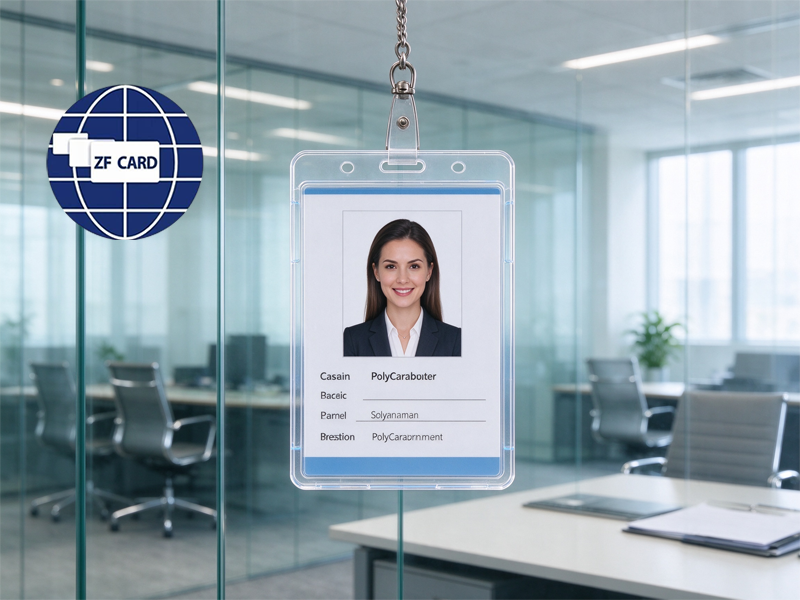
Mechanical behavior is the next gap. Repeated flexing puts a white stress line in PVC, and after enough cycles the card cracks along that line. Polycarbonate absorbs bending and impact much better, which matters for badges on lanyards, cards carried in back pockets, and credentials dropped on tile floors. During lamination the PC layers fuse into one monolithic sheet, leaving no peelable seam; a counterfeiter cannot pry the layers apart with a knife and a heat source the way a surface-printed PVC card can be opened.
Chemical exposure is where daily cleaning habits matter. PVC can be attacked by plasticiser migration, certain solvents, sunscreen, and some alcohol-based disinfectants, turning tacky or cloudy after regular wipe-downs. Polycarbonate holds its gloss against most of these agents and cleans without deforming. Hospitals, food-processing plants, and industrial sites that sanitize credentials several times a week often find that this resistance alone justifies the stronger substrate.
Security is the strategic difference. A PVC ID usually carries its photo and text on the printed surface, where artwork can be overprinted, lifted, or re-covered. A polycarbonate id card is typically personalised by laser, which ablates a buried layer inside the body and burns the holder's image into the substrate. Once engraved, that image cannot be wiped or transferred. Holographic patches, UV ink, guilloche backgrounds, and micro-text can likewise be sealed between PC layers instead of applied on top, where they peel.
Buying a polycarbonate id card is also a supplier-capability question. PC lamination needs roughly 150–180°C and substantial platen pressure, well above a standard PVC press recipe. A plant running a converted PVC line can come away with bubbled, cloudy, or warped PC cards. Check whether the converter owns a dedicated PC press and mills and seals chip modules in-house; outsourced milling is where cracked modules and leaking sealant usually appear. Asking to see that station on a video call is a quick way to separate factories from traders.
Chip and interface load differ as well. PVC cards comfortably carry contact chips, magnetic stripes, and simple contactless inlays. Polycarbonate handles dual-interface modules and larger antenna structures with more mechanical stability, which is why e-passport covers, national IDs, and multi-application credentials lean on PC. A project combining a DESFire contactless badge, a contact module, and a laser-engraved photo is a strong candidate for the PC substrate, because the card body has to carry all three without stress.
Appearance reads differently on the two materials. PVC prints vividly and cheaply, in gloss or matte lamination. Polycarbonate can run clear, tinted, or deep opaque, which is what transparent-window badges and premium credentials are built from, and it takes fine textures and a rigid, weighty feel that signals authority. For a police credential, a government permit, or an airport badge, that hand-feel establishes legitimacy before anyone reads the text.
Cost has to be measured across the card's life cycle. PVC is cheaper to buy, reprint, and replace when it wears out. A polycarbonate id card costs more up front but typically lasts several times longer, cuts the wear that forces early reissue, and carries features that reduce fraud losses. Government programs amortise the premium across a decade and come out ahead; a small gym turning over membership cards every year may never recover it.
The use-case division follows directly. Pick polycarbonate for national IDs, driver licences, residence permits, visas, police and military credentials, airport and controlled-site badges, banking back-office passes, and any credential where forgery grants real physical or financial access. Stay with PVC for office access, gym and retail membership, event passes, visitor badges, loyalty cards, and gift cards, where turnover is high and the threat is low.
A few common misconceptions are worth correcting. Polycarbonate is moisture-resistant, not submersible; it still has limits around prolonged water exposure. PVC can carry a chip — millions of hotel keys prove that. Specifying PC but sending artwork laid out for a PVC personalisation printer causes registration trouble, and a laser personaliser has to be tuned to the exact PC layer structure the factory used. These are specification gaps, not material failures.
Run the decision through four questions before choosing. How long must the card last? What happens if it is forged? What will it meet — heat, chemicals, bending, moisture? Which personalisation and encoding equipment do you already own? Answering those honestly usually points to one substrate, and a physical sample tested on your own reader or printer confirms what the datasheet suggests. A flat sample in a wallet is the real test.
This is the comparison ZF Card (Zhanfeng) has helped buyers resolve for twenty years as a China-based original card manufacturer. We run dedicated polycarbonate lamination and PVC lines side by side, so a project can be quoted on whichever substrate fits, without a preference toward whatever happens to be in stock. We produce polycarbonate id cards for government-oriented programs, high-security badge deployments, and banking and industrial clients, alongside PVC cards for access, membership, and hospitality volumes, in more than a hundred countries.
Our in-house work covers PC lamination, chip-module milling and sealing, hologram and UV layer insertion, offset and screen printing, laser-ready layer structures, encoding, and 100% read and electrical testing. We hold ISO 9001 and ISO 14001 certification and keep RoHS, REACH, and CE documentation ready for export buyers. Before quoting, English-speaking engineers ask about your personalisation equipment and readers, then recommend the substrate that fits — PVC for a short lifecycle, polycarbonate for a credential that must resist tampering for a decade. Every encoded card is read-tested after assembly, lot samples are retained for traceability, and the artwork, data file, and tooling stay on record for repeat orders.
Either way, we send a physical sample you can bend, wipe, laser-burn, and tap before committing to production. ZF Card ships free PC and PVC ID card sample packs to government-adjacent issuers, security integrators, and brand buyers worldwide — you cover the courier, and we include a comparison card of each substrate printed with your artwork and encoded to your chip spec.
Tell us your project's lifetime, threat model, environment, and personalisation equipment, and we will reply within one business day with a substrate recommendation, a firm lead time, and a factory-direct quote. Stop comparing two materials that look identical on a spec sheet — request your free polycarbonate id card sample today and judge the stiffness, the seal, and the laser burn yourself.