
 English
 Russian
 French
 Spanish
 Portuguese
 Italian
 Arabic
 German


China Warranty Card Designs & Price: Custom PVC Guarantee Cards, OEM Printing, Low MOQ & Free Samples
- Nov 12 , 2026
- By: Guangzhou Zhanfeng Smart Card Technology Co.,Ltd.
- Follow Us
When buyers search for a china warranty card design template price comparison, they are usually not shopping for a flat piece of plastic with a logo. They are looking for a certificate that proves a purchase, protects a brand against fake claims, and reminds the customer where to return. The price that comes back in the reply depends almost entirely on how the card is built, printed, and personalized, not on the card alone. This guide explains what goes into a warranty card design, which features move the cost, and how to read a quote before you send a deposit.
A warranty card is a legal-style companion to the product, not a business card. It sits in the box or the wallet for the life of the purchase, so its job is to survive handling, reassure the buyer, and give the brand a controlled record of the sale. For watches, jewelry, electronics, leather goods, eyewear, and cosmetics, it also carries the brand's visual identity the moment the customer opens the package. A thin, loosely printed card weakens that impression even when the product inside is premium.
Every functional warranty card carries a fixed set of information. The brand name and logo come first, followed by the product name or model, a serial or batch number, the purchase date, the dealer or retailer name, the warranty terms and period, customer service contact, and often a QR code or barcode linking to a registration page or verification portal. Missing one field weakens the card as a proof of purchase; duplicating the sales receipt onto the card means the warranty record survives even if the paper invoice is lost.
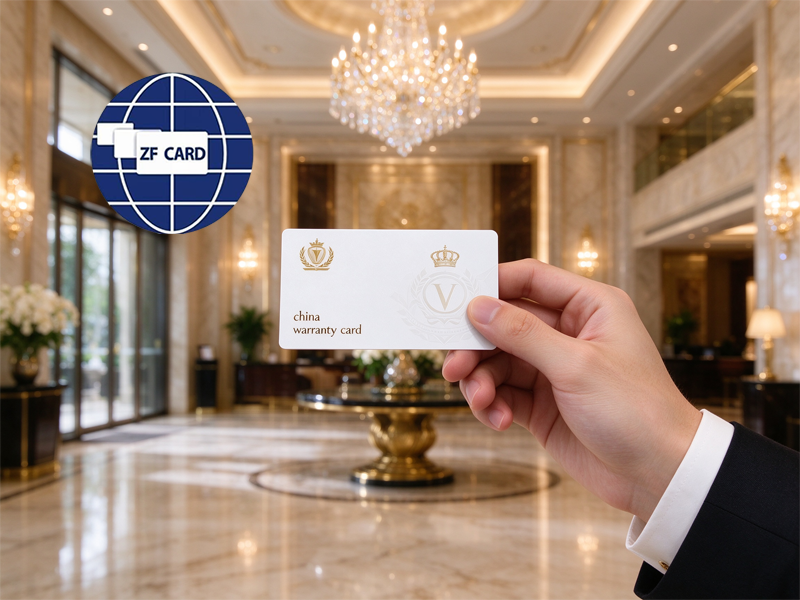
Material choice sets the baseline. PVC is the standard: rigid, water-resistant, and durable enough to live in a wallet, available in CR80 and thicker gauges. PETG is a flexible alternative used where the card must bend without cracking. Paper cards with matte lamination are the lowest-cost option but crease and absorb moisture. A warranty card for a watch or jewelry brand that expects a multi-year shelf life is almost always printed on PVC, because it holds color and survives being carried alongside keys and coins.
The design itself runs along two paths. A pre-built warranty card template gives you a fast, proven layout: logo block, serial field, warranty text, and a code area already arranged for balance and readability. A fully custom design follows the brand's own grid, type system, and color palette. Either path needs a clear hierarchy — the brand and the product stand out, the serial and code stay machine-readable, and the legal text stays small but legible. Design files are normally delivered in AI or PDF with fonts outlined, colors in CMYK, and bleed extended beyond the cut line.
Surface finishing is where premium cards separate from ordinary ones. Offset or screen printing handles the base artwork; hot foil stamping in gold or silver adds a metallic logo; embossing and debossing raise or press the name; a spot UV layer creates a glossy shine over a matte card; and domed epoxy coats the face for a raised, polished look. Matte film protects fingerprints, gloss film makes colors pop. Each added finish adds a setup step and a cost, so the finish list should match the brand's positioning rather than cover every option at once.
Variable data is the part most likely to be missed in design review. If each card carries its own serial number, barcode, or QR code tied to a database, the printer must set up variable data imposition and verify that no number repeats. The code must be printed large and clean enough to scan on the first attempt; a faded or distorted QR code fails the verification page it points to. Confirm whether the factory writes the data, exports a matched CSV, or works from your own number list, and whether the code area is locked after encoding.
A china warranty card design template price quote breaks down into visible line items rather than one flat number. The base is the material and thickness; then come the number of print colors, any foil, embossing, UV, or doming, the variable-data encoding, the quantity tier, and the packaging — individual sleeves, folded envelopes, or box inserts. Lower minimum order quantities raise the unit cost because setup labor is spread over fewer cards, while larger runs bring the price per piece down. Ask for a line-item quote that separates these so you can see which finish to drop when the budget tightens.
The common mistakes repeat across orders. A QR code printed too small or over a dark background will not scan, and the verification flow breaks on the customer side. Colors shift when the artwork is sent in RGB instead of CMYK. Serial numbers repeat when the data file has not been checked against the encoder list. Thin PVC warps or cracks in a pocket, and cheap ink fades against sweat or hand cream. Each of these shows up at proof stage if the proof is read and tested, not just admired.
The proof stage is where the design becomes physical. A digital proof shows layout and color balance; a physical proof shows the actual thickness, foil shine, and code readability on your own scanner or phone. Check that the serial field aligns with the imprint area, that the foil does not cover the code, and that the card bends without a white stress line. Approval on a flat screen cannot catch registration drift on a real card, so a physical sample should always precede the production run.
Scope the project before comparing quotes. List the card format and material, finish options, whether variable data is required, the annual quantity and any repeat orders, the packaging, and the artwork format you can supply. A supplier who answers these specifics can quote accurately; one who sends a single low number without asking about data, finish, or material has priced the cheapest possible version. That gap usually appears when the first batch arrives.
This is the design and printing support ZF Card (Zhanfeng) has delivered for twenty years as a China-based original card manufacturer. We produce custom PVC guarantee and warranty cards for watch, jewelry, electronics, leather, eyewear, and cosmetics brands, alongside member and access cards, in more than a hundred countries. Our in-house line covers PVC and PETG material cutting, offset and screen printing, foil stamping, embossing, spot UV, variable serial and QR encoding, and packing, so a card moves from artwork to finished unit without a middle handoff. When you request a china warranty card design template price from our team, the reply separates material, print, finish, encoding, and packaging on one line-item sheet.
We hold ISO 9001 and ISO 14001 certification and keep RoHS and REACH documentation ready for export buyers. Our English-speaking account engineers review your artwork for CMYK conversion, code size, and bleed before quoting, then send a physical proof matched to your template before the press run. Common card formats and stock materials are held in stock, which supports a low minimum order for brand owners testing a new product line, and the artwork, data file, and print film are retained for repeat orders.
The fair way to judge a warranty card design is to hold the finished card in hand and scan its code yourself. ZF Card ships free China warranty card design template price sample packs to brand owners, distributors, and packaging converters worldwide